

Synthetic Bristle Weather Resistance: Polymer Blends for Brushes Used in High-Humidity or Cold Environments
Synthetic Bristle Weather Resistance: How Polymer Blends Enhance Brushes in High-Humidity and Cold Environments
In the global brush industry, from cosmetic tools to industrial applicators, performance reliability in extreme environments has become a critical consumer and professional demand. Traditional bristle materials—whether natural animal hair or single-polymer synthetics—often falter in high-humidity tropical regions or freezing cold climates: natural hair succumbs to mold and brittleness, while single-polymer fibers like nylon (PA) lose elasticity in humidity or crack in sub-zero temperatures. Today, synthetic bristle technology is addressing these challenges through engineered polymer blends, a material science breakthrough that balances weather resilience with functional durability.
The limitations of conventional materials are well-documented. In high-humidity areas (e.g., Southeast Asia, coastal regions), brushes with pure PA bristles absorb moisture, leading to swelling, shape distortion, and bacterial growth—cosmetic brushes, for instance, may shed or fail to pick up pigments evenly after weeks of use. In cold environments (e.g., Nordic countries, winter construction sites), single-polymer PET bristles stiffen, losing the flexibility needed for smooth application, whether for makeup or paint. These flaws highlight a clear need: bristles must resist moisture absorption, maintain elasticity across temperature extremes, and retain structural integrity over time.
Enter polymer blends: a tailored fusion of polymers that leverages the strengths of each component while mitigating weaknesses. Key players in this配方 include polyamides (PA), polyesters (PET), polybutylene terephthalate (PBT), and thermoplastic polyurethanes (TPU). For high-humidity resistance, PET’s low moisture uptake (typically<0.5% vs. PA6’s 3-4%) makes it a cornerstone; blending PET with PA (e.g., 60% PET/40% PA) reduces water absorption by 60% while preserving PA’s abrasion resistance. In cold climates, TPU—a flexible elastomer—adds低温韧性: a 5-10% TPU blend with PBT lowers the bristle’s glass transition temperature (Tg) by 15-20°C, preventing brittleness even at -25°C.
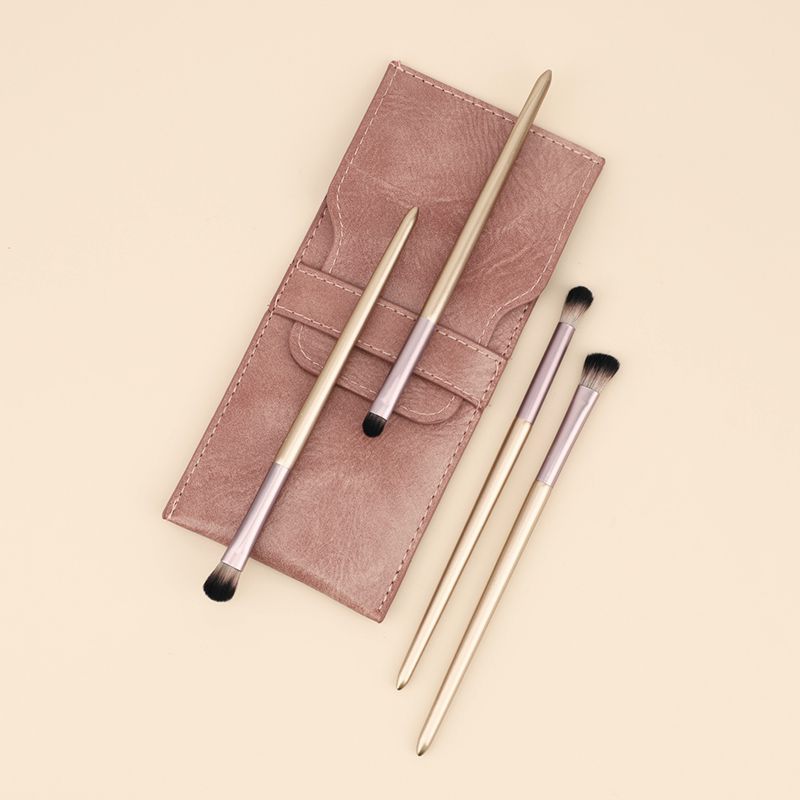
The science behind these blends lies in interfacial compatibility. Modern extrusion techniques ensure uniform mixing of polymers, avoiding phase separation that would weaken the bristle. For example, a PA/PET blend with a 2% compatibilizer (e.g., maleic anhydride-grafted polyethylene) creates a cohesive matrix: PA provides tensile strength, PET enhances moisture barrier properties, and the compatibilizer ensures stress transfers evenly under flexing. Lab tests validate this: such blends retain 92% of their initial elasticity after 1,000 bending cycles at 90% humidity, compared to 65% for pure PA. In -20°C cold-flex tests, TPU/PBT blends show only 8% stiffness increase, versus 35% for pure PBT.
Real-world applications underscore the impact. A leading cosmetic brush brand targeting Southeast Asia recently switched to 70% PET/30% PA blended bristles; user feedback notes “no bristle warping after 3 months in a humid bathroom” and “consistent powder pickup.” In Northern Europe, industrial paintbrushes using 10% TPU/PBT blends report “no bristle breakage during winter construction,” with tool lifespan延长 by 40%. These cases reflect a broader trend: brands now prioritize “environment-specific bristle engineering,” collaborating with material suppliers to customize blends for regional climates.
Looking ahead, sustainability is shaping next-gen blends. Bio-based polymers like PLA (polylactic acid) are being integrated into PA/PET mixes, reducing carbon footprints without sacrificing weather resistance. A recent PLA/PA blend prototype retained 88% humidity resistance while cutting petroleum-derived by 30%. Additionally, AI-driven配方 optimization is emerging, using machine learning to predict blend performance based on climate data (e.g., average humidity, temperature ranges), enabling faster development of hyper-targeted solutions.
In conclusion, polymer blends are redefining synthetic bristle performance, turning environmental challenges into opportunities for innovation. By harmonizing the strengths of PA, PET, TPU, and emerging bio-based materials, the industry is not just creating more durable brushes—it’s enabling reliable tool performance anywhere, from the rainforests of Brazil to the frozen tundra of Norway. As consumer expectations for resilience grow, these engineered blends will remain at the forefront of brush technology evolution.


